Who Pays for Police Technology? Public Records Show Private Funding Behind Wichita Police Equipment
Public records obtained by The Public Records & Civil Rights Project, Inc. (Record Rights) provide a look at how private organizations and businesses have helped fund equipment and technology used by the Wichita Police Department.
The records include funding for police drones, ballistic vests and restraint equipment. The records themselves do not establish wrongdoing. They do, however, illustrate why transparency regarding private funding of public law-enforcement operations matters.
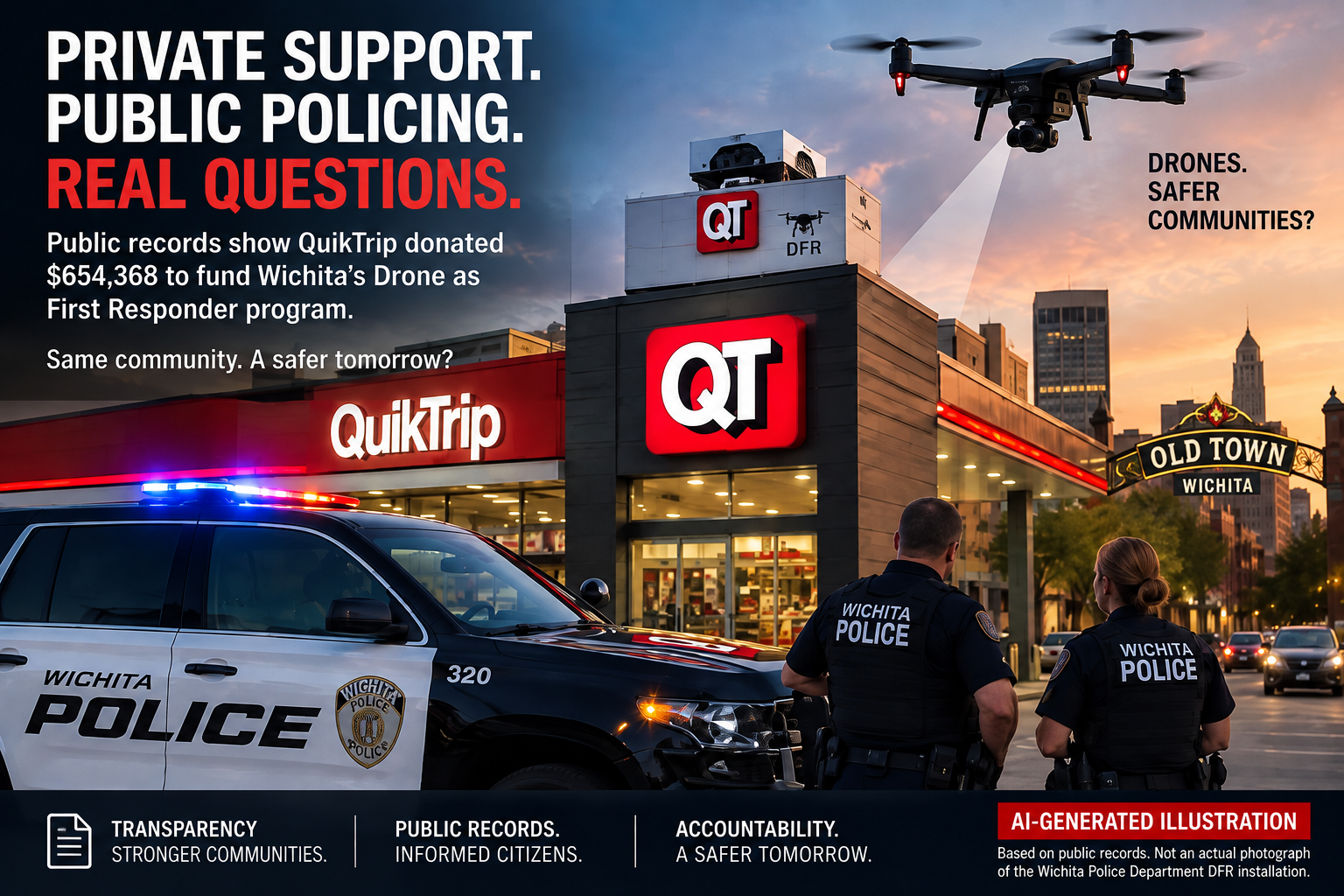
$654,368 for Wichita’s Drone as First Responder Program
In December 2025, the Wichita City Council considered a $654,368 donation from QuikTrip to fund an expansion of the Wichita Police Department’s Drone as First Responder (DFR) program.
The donation funded a DFR Hive to be installed on top of the QuikTrip store at 1010 E. Douglas. According to the City’s agenda report, Wichita already operated a DFR Hive at Lincoln and Broadway.
The City’s report explains that the East Douglas location would allow the drone to monitor Old Town and the surrounding community and allow officers to obtain aerial “eyes on” an incident more quickly when something occurs in or around the business. The report also identifies deterrence of suspicious activity and street racing as anticipated uses.
The underlying donation form is even more specific about where the money was directed:
“Drones as First Responder (DFR) Hive Pilot Program at 1010 E Douglas QT location.”
What does $654,368 purchase?
The Axon quote included with the City’s records shows a five-year program with a total quoted cost of approximately $654,368.55.
The equipment and services listed in the quote include three Skydio X10 dock hardware kits, DFR equipment kits, DroneSense Cloudstream, Skydio DFR Command, maintenance and repair services, deployment services and parachute plans.
The City’s report states that QuikTrip’s donation covers the five-year program. If Wichita continues it beyond that period, maintenance and subscription services were then estimated at approximately $61,000 annually per hive.
The Wichita Police and Fire Foundation Is Funding Equipment Too
Separate records show the Wichita Police and Fire Foundation providing money connected with other WPD equipment.
A March 11, 2026 donation form records a $23,000 donation from the Wichita Police and Fire Foundation. The actual form identifies its purpose as reimbursement for WPD WRAP restraints.
Wichita Police and Fire Foundation Donation for WRAP restraints 3.11.26.pdf
Another March 11 donation form identifies approximately $35,462 from the Foundation; the handwritten description on the document states “Reimbursement: WPD/Ballistic Vests.”
Records also show other financial transactions involving the Foundation. A July 22, 2025 City invoice charged the Wichita Police Foundation $8,621.37 for “Other Police Revenue — National Police Week.”
A separate City payroll deduction report contains a deduction category labeled “Wichita Police Foundation.”
Why These Records Matter
Private donations to law enforcement do not, by themselves, demonstrate misconduct. They do create legitimate transparency questions when private money helps purchase technology or equipment used to exercise governmental authority.
For example:
- What agreements accompany private donations?
- Does a donor have any role in determining where equipment is located or how it is deployed?
- What policies govern the resulting surveillance technology and retention of its data?
- What records are created when the technology is deployed?
- Who can access drone footage and associated data?
- Are there additional costs to taxpayers after donated funding expires?
- How much privately funded equipment is currently being used by local law enforcement?
The QuikTrip records are particularly useful for illustrating these questions because the City documents identify the donor, the amount, the equipment, the location and the stated purpose.
The City’s own documentation says the East Douglas DFR Hive will provide coverage of Old Town and the surrounding community.
That makes the funding structure a matter worth understanding—not because private funding necessarily means something improper occurred, but because public policing should remain publicly transparent regardless of who paid for the equipment.
Records Rights will keep following the records.
The Public Records & Civil Rights Project, Inc. uses public records to help communities understand how government agencies operate, how public authority is exercised, and how decisions affecting civil rights and public accountability are made.
Transparency isn’t anti-police. Transparency is part of accountable government.
Attachments
Leave a Reply