
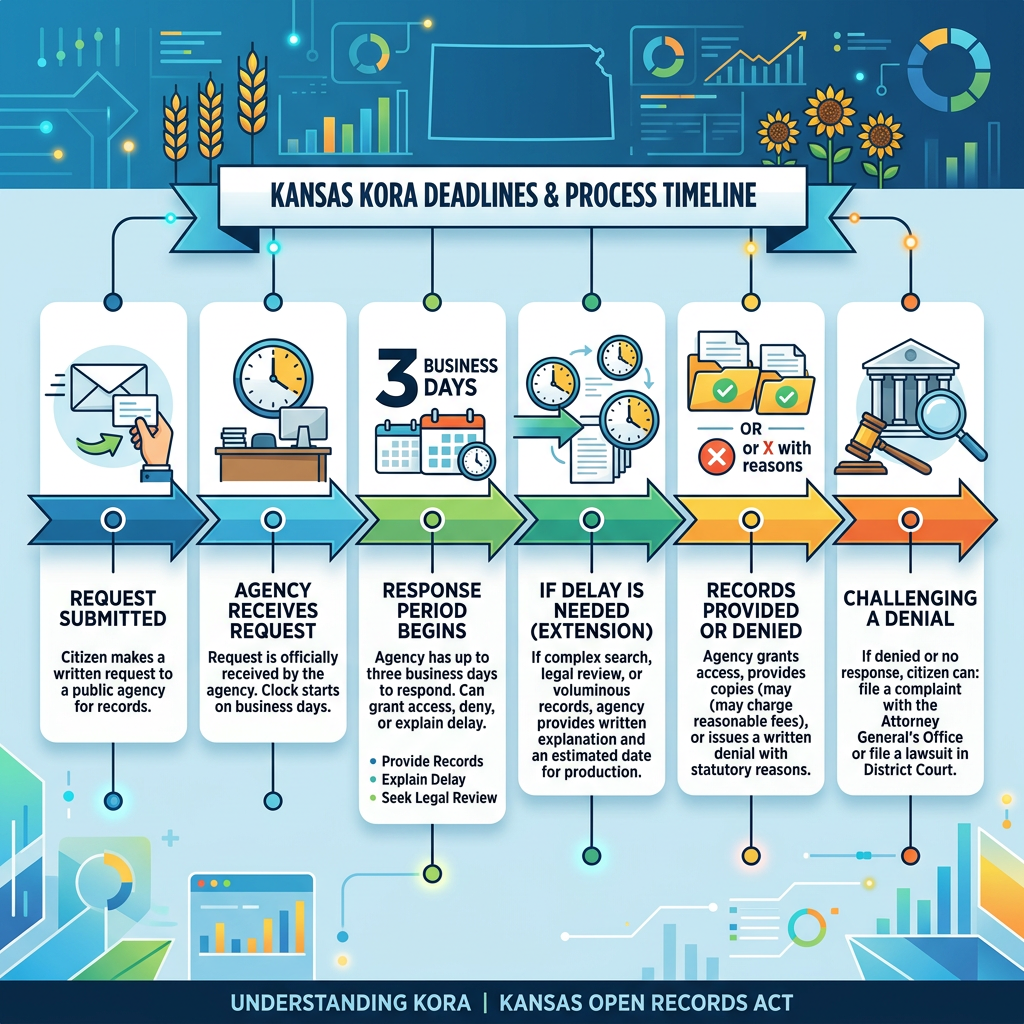

Kansas agencies are generally required to respond to public records requests within specific timeframes established under the Kansas Open Records Act (KORA), K.S.A. 45-215 et seq.
While agencies are not always required to immediately produce records, KORA requires timely responses and communication regarding the status of requests. Understanding these timelines can help requesters better track requests, follow up appropriately, and identify potential compliance issues.
This overview summarizes common KORA response practices and important considerations for individuals requesting public records in Kansas.
What is the Three-Business-Day Requirement?
Under the Kansas Open Records Act (KORA), agencies are generally expected to respond to records requests within three business days. However, this does not necessarily mean the agency must fully produce all requested records within that timeframe.
Instead, the three-business-day period typically requires the agency to acknowledge the request and communicate its status. A response may include:
confirming receipt of the request,
requesting clarification,
providing a fee estimate,
explaining that additional time is needed,
identifying records exemptions,
or providing an anticipated timeline for production.
Large requests, archived records, legal review, redactions, or coordination between departments may require additional time before records can be fully produced.
While KORA allows reasonable additional time in some situations, agencies are still expected to respond in good faith and avoid unnecessary delays. Repeated unexplained extensions or lack of communication may raise questions regarding compliance with KORA response obligations.
What Counts as a Response?
Under KORA, an agency response does not always mean the immediate production of records. In many situations, the law only requires the agency to acknowledge the request and communicate its status within the applicable response period.
Examples of agency responses may include:
acknowledging receipt of the request,
requesting clarification regarding the records sought,
providing a fee estimate,
producing responsive records,
partially producing records while additional review continues,
or denying records under a claimed exemption.
A response should generally provide enough information for the requester to understand the status of the request and any additional steps or delays involved.
Can Agencies Extend Time?
Yes. Agencies may require additional time depending on the nature and scope of the request.
Additional time may be needed for:
large or complex requests,
archived or off-site records,
legal review,
third-party review,
review for confidential information,
or redactions required under statutory exemptions.
While KORA may allow reasonable extensions in some situations, agencies are still expected to respond in good faith and avoid unnecessary or unexplained delays.
Common Issues Requesters Encounter
Requesters sometimes encounter challenges during the records request process, including:
- vague or unclear delay explanations,
- repeated extensions without meaningful updates,
- excessive or unclear fee estimates,
- incomplete record productions,
- missing attachments or metadata,
- delayed communications,
- or failure to identify the specific exemption used to withhold records.
Maintaining organized records and requesting clarification when necessary can help improve accountability and communication during the process.
What Requesters Should Keep
Individuals submitting public records requests should maintain copies of all request-related communications and documents.
Important records to keep may include:
copies of submitted requests,
submission confirmations,
timestamps,
emails and correspondence,
fee estimates and invoices,
agency responses,
denial letters,
and copies of produced records.
Maintaining a clear timeline can help document the request process and assist with follow-up communications if needed.
Important Reminder
This article is provided for educational and informational purposes and does not constitute legal advice
Leave a Reply